
Project Structure
PODtrust
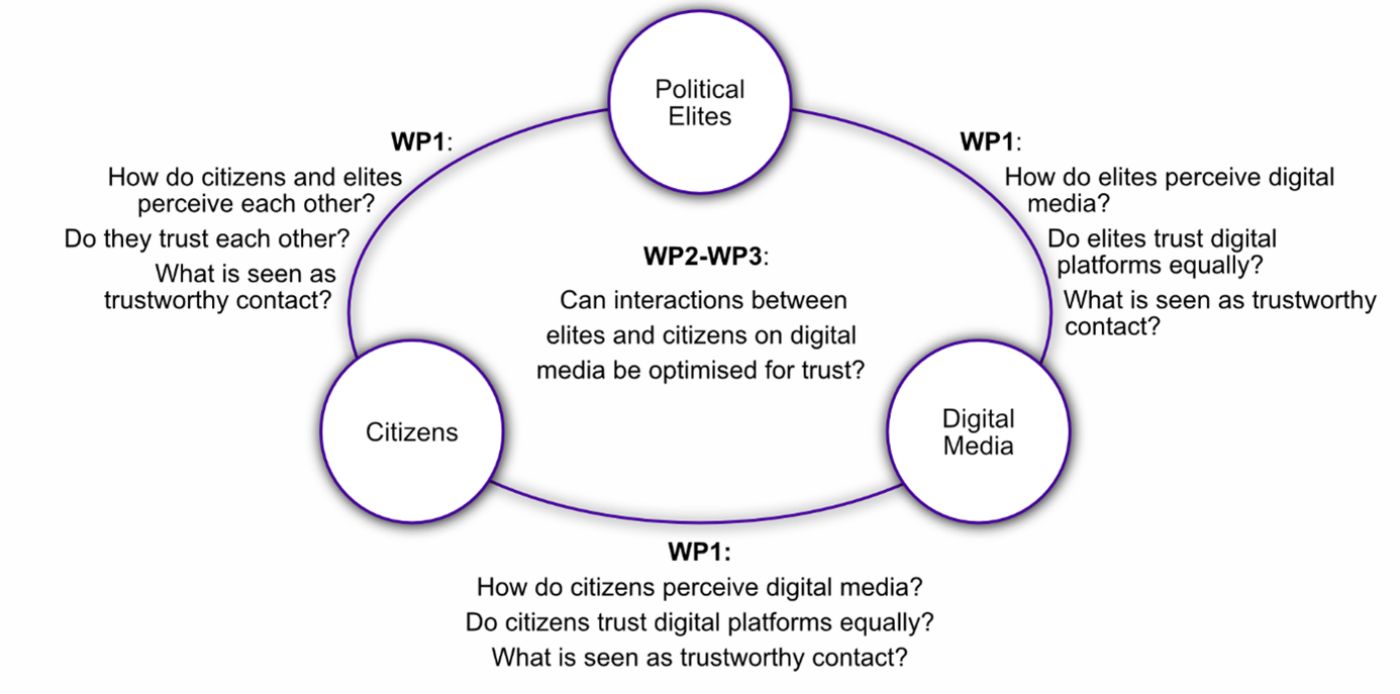
The PODtrust project is structured around three interlinked work packages (WPs) that collectively examine how citizen characteristics, digital media use, and elite communication shape political trust. WP1 explores current perceptions and practices of digital contact; WP2 experimentally tests how different forms of contact affect trust; and WP3 applies these findings in real-world political contexts to inform democratic practice.
WP1 – Understanding Current Digital Contact
● Focus: Citizen and elite perceptions of digital media
● Methods: Survey audits, elite interviews
WP2 – Testing Interventions
● Focus: Experimental testing of digital contact formats (chatbots, influencers, etc.)
● Methods: Experimental surveys
WP3 – Field Implementation and Validation
● Focus: Real-world application of interventions with political actors
● Methods: Field experiments
Work Package 1
Work Package 1 examines existing perceptions and uses of digital media for political contact, with a view to inductively updating existing models of political trust to capture the changing dynamics of citizen-elite contact on digital media (O1). This WP aims to understand differences in political trust judgements based on characteristics such as being part of a marginalised group, being based in a rural area, being under the age of 25, and being from different national contexts (O2).
Questions
● How do citizens and elites perceive different digital media?
● How do trust judgements about political actors and digital media differ across groups?
● What modes of digital contact exist and how can these best be categorised and theorised?
Methods
Survey audit, interviews with elites (50 in each country).
PODtrust aims to conduct a comprehensive audit of existing surveys and in-depth interviews’ questions related to three key themes:
(1) political trust,
(2) political marginalization and minority groups,
(3) digital interactions between politicians and citizens.
This audit will encompass survey instruments developed at three distinct scales:
– the global level (e.g. WVS);
– the regional level – primarily focusing on Europe-related surveys (e.g.. ESS, Eurobarometer), but also including selected cases from Asia and the United States;
– the national level – concentrating on state-funded research projects (e.g. the Austrian Science Fund (FWF), the Belgian Science Policy Office (BELSPO), the French National Research Agency (ANR), the German Research Foundation (DFG), the Dutch Research Council (NWO), the Research Council of Norway (RCN), the Swedish Research Council (SRC), the Swiss National Science Foundation (SNSF), and the Economic and Social Research Council (ESRC) of UK Research and Innovation (UKRI) among others).
The resulting audit across these three thematic areas will be compiled into a single publicly accessible and searchable file and will be available via data dissemination platforms (such as the MEDEM website or GESIS).
Work Package 2
Work Package 2 then tests a variety of interventions that vary the type and form of digital contact between citizens and elites to determine their impact on political trust (O3).
Questions
● How can the form of digital interaction (direct, synthetic, mediated) and type of digital contact be adapted to promote political trust?
● Do interventions have uniform effects on trust across all target groups?
Methods
Experimental survey
Work Package 3
Work Package 3 verifies these findings in the field by collaborating with political elites to inform democratic practice (O4). Cumulatively, we use these insights to generate and test a conception of trust-building in politics that recognises the multifaceted factors that affect trust judgements, and the importance of social interactions and attitudes therein (O1).
Questions
● Are experimental interventions replicated in real-world environments?
● How do political elites perceive the impact and value of interventions?
● How do citizens perceive the impact and value of interventions?
Methods
Field experiment